Key Takeaways
- Data centres face a massive surge in power demand, driven by cloud growth and high-density AI infrastructure, leading to grid constraints and refused connections across Europe.
- Microgrids offer a crucial workaround, enabling data centres to generate their own power and operate independently, thus unlocking new development sites and speeding up construction.
- Research shows that a “balanced” energy transition path, incorporating balancing power plants alongside renewables and storage, is significantly more cost-effective and leads to lower emissions and less wasted energy than a “renewables and storage” only approach.
- Data centre microgrids, particularly those utilising internal combustion engines with renewables and batteries, offer the most cost-effective solution for powering AI facilities, with emissions similar to current Northern European grid emissions and lower levelised production cost.
- In addition to self-sufficiency for data centre operators, these microgrids have the potential to provide dispatchable power to the wider grid, offering significant benefits in terms of grid stability, balancing higher levels of renewables, reducing grid infrastructure spending, and improving public perception of the industry.
Executive Summary
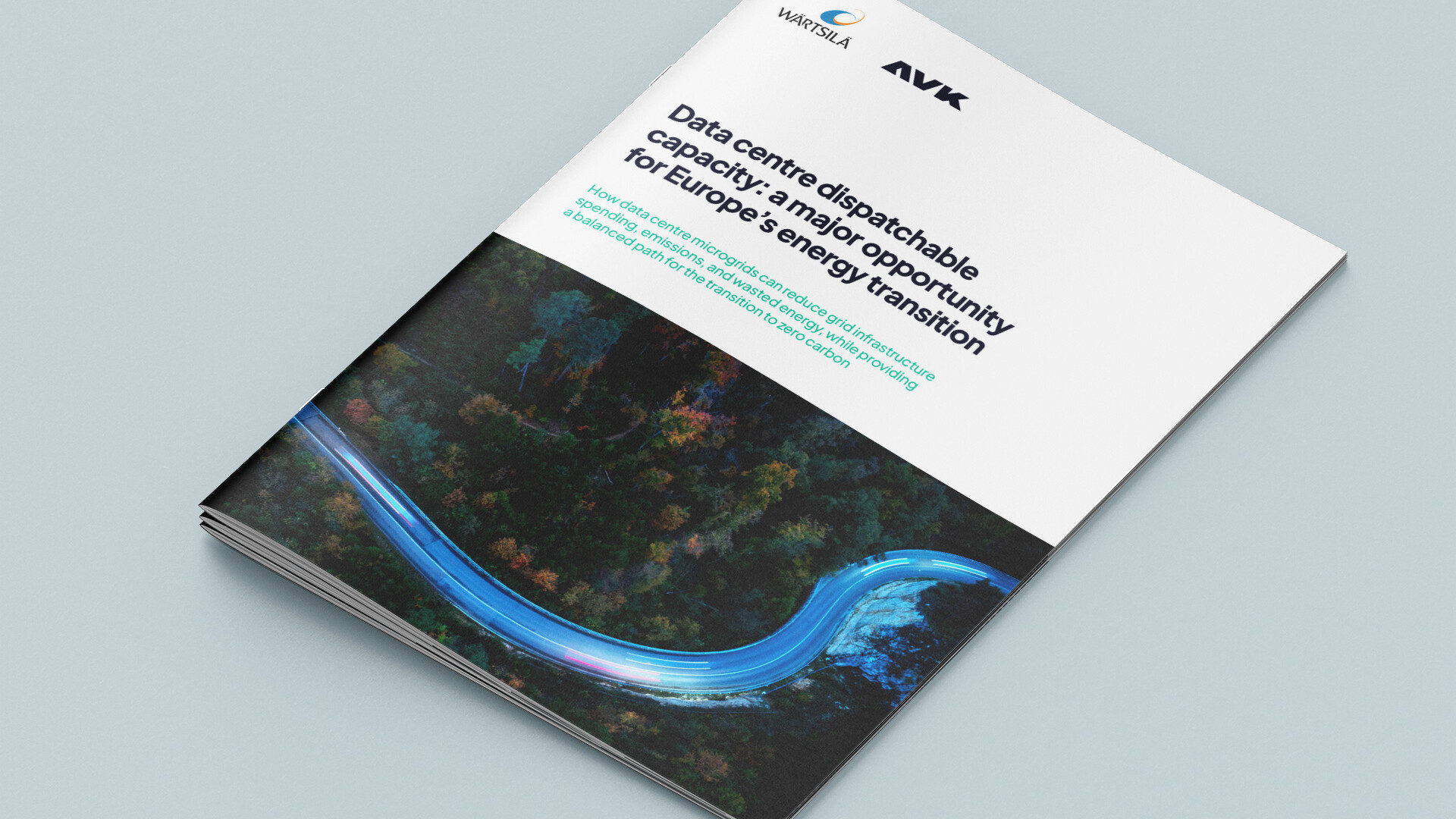
The burgeoning demand for data centre capacity across Europe presents both a formidable challenge and a unique opportunity for the continent’s energy future. As cloud services expand and artificial intelligence workloads intensify, data centres are consuming an ever-increasing amount of power, straining existing grid infrastructure and leading to significant delays in new connections. This urgent situation calls for innovative solutions, and according to our new paper with partner Wärtsilä, the answer lies in the strategic deployment of data centre microgrids.
The Looming Power Crisis and the Microgrid Solution
The scale of the challenge is stark. McKinsey estimates that Europe’s data centre capacity demand will soar from 10 GW today to approximately 35 GW by 2030, a 250% increase. Goldman Sachs projects an even more dramatic scenario, foreseeing a potential 10-15% boost in Europe’s overall power demand by 2030, with data centres accounting for a staggering 170 GW pipeline. This unprecedented growth is already resulting in refused grid connections and operational constraints, with Gartner predicting that 40% of existing AI data centres will be power-constrained by 2027. Countries like Ireland and the Netherlands have already effectively halted new data centre permits requiring grid connections.
In response to this growing crisis, the digital infrastructure industry is increasingly turning to microgrids. These small-scale, self-contained power grids can operate independently, generating electricity for localised areas. This ‘behind the meter’ approach allows data centres to bypass grid connection delays and unlock new land parcels for development, speeding up their construction and operation. The European microgrid market, currently valued at approximately EUR 3.3 billion, is forecast to grow by 16% annually over the next seven years, reaching over $16 billion.
The Balanced Path to Net Zero: A Wärtsilä Perspective
A recent global paper by Wärtsilä modelled global power generation as a single, aggregated system to explore optimal pathways to net zero by 2050. Two primary paths examined were ‘Renewables and storage’ and ‘Balanced’.
The ‘Renewables and storage’ path relies heavily on massive increases in variable renewable energy (solar and wind) and energy storage capacity. While seemingly ideal, this approach demands an enormous land footprint for infrastructure (comparable to the size of continental Europe) and results in significant renewable energy curtailment – a staggering 55% of total renewable generation by 2050. This wasted energy, equivalent to meeting global power demand for over 15 years, underscores the inefficiencies of relying solely on intermittent sources.
In contrast, the ‘Balanced’ path integrates balancing power plants (such as flexible engine power plants) alongside renewables and energy storage. This approach, while still deploying substantial renewable capacity, offers critical flexibility and requires significantly less installed capacity for renewables and storage.
The financial implications are equally compelling. The total system cost for the ‘Renewables and storage’ path is estimated at EUR 155 trillion between 2025 and 2050, while the ‘Balanced’ path offers a cumulative saving of over EUR 65 trillion, costing approximately EUR 90 trillion. This substantial cost disparity is largely attributed to the overcapacity and high curtailment inherent in the ‘Renewables and storage’ model. Furthermore, the ‘Balanced’ path achieves a more rapid decline in emissions, resulting in a near 21% additional reduction in cumulative emissions by 2050 compared to the ‘Renewables and storage’ pathway.
Data Centre Microgrids in Action: The Modelling Results
Applying these principles to the data centre industry, Wärtsilä further modelled four microgrid configurations for an 80 MW AI data centre in Northern Europe, assessing cost-effectiveness and reliability. The results decisively favour Model 4: ‘renewables + internal combustion engines + batteries’. This optimal model combines 74 MW of wind and 55 MW of solar capacity with internal combustion engines (ICE) and battery energy storage systems (BESS). Critically, it also has a low Levelised Cost of Energy (LCOE) at 108 EUR/MWh, significantly below average electricity prices in the UK, Ireland, and
Netherlands (which exceeded 200 EUR/MWh in H1 2024).
Beyond cost, Model 4 in the paper also boasts impressive environmental credentials. Its operational emissions are approximately 180 g/kWh, which is already low when compared to typical grid generation emission levels from Germany, Ireland, the Netherlands, and the UK. With grid connection and flexible balancing services, emissions could drop to below 10 g/kWh, even without sustainable fuels. The modularity and flexibility of medium-speed internal combustion engines, which can be optimised for varying load requirements and are compatible with future sustainable fuels, give it significant environmental advantages.
Grasping the Grid Opportunity
The implications of these findings extend far beyond individual data centres. If just a fraction of new data centres were to adopt the optimal microgrid model outlined in this paper, they could collectively create a substantial reserve of dispatchable capacity which could balance huge amounts of new renewable power.
This capacity could then be shared with the European grid, balancing fluctuations from renewable energy sources and accelerating the overall transition to clean power.
The benefits are multi-faceted. Data centre operators gain increased resilience, reduced costs, and improved sustainability profiles. Governments benefit from reduced infrastructure investment obligations, allowing them to focus on critical transmission upgrades. The wider public could see price reductions as freed-up capital improves power tradability and stimulates the market. Furthermore, providing dispatchable power to the grid could significantly improve public perception of data centres, countering criticisms about their growing energy consumption.
Achieving this transformative shift requires a change in mindset and increased cooperation among all stakeholders. Data centre operators must recognise their assets not just as standby or prime power sources, but as dispatchable assets capable of supporting decarbonisation and resilience. Power solution providers, like AVK, are expanding their portfolios to include load balancing services and trading. Policymakers and regulators also need to regulate in favour of dispatchable power.
In conclusion, the path to a sustainable and resilient energy future for Europe, especially amidst soaring data centre demands, lies in embracing the dispatchable capacity offered by microgrids. By fostering collaboration and adopting these innovative solutions, Europe can simultaneously accelerate its digital transformation and achieve its ambitious climate goals faster and more cost-effectively.
You can download the paper here.