Back to articles

Europe’s First Microgrid: Pure DC in Dublin, Ireland

Date
16 March 2026
Author
AVK
Read Time
11 min

Europe's first microgrid in the data centre space has launched at Pure DC's site in Dublin. Operating off-grid and capable of remaining so, the facility on its completion will have an installed capacity of 110MW - 30MW generated from each permanent energy centre, and 20MW from a battery energy storage system (BESS).

Europe's first microgrid facility for data centres

Key points  

  • Off-grid, on-site power generation as the primary energy source, ensuring full energy independence from the national grid, delivered through Europe’s first microgrid of its kind. The system is built across three interconnected Energy Centres (EC1, EC2, EC3), each capable of generating up to 30MW, complemented by a 20MW Battery Energy Storage System (BESS), bringing the total capacity to 110MW. A 10MW temporary energy centre was also deployed to ensure uninterrupted power during the construction and commissioning phase. 
  • The microgrid is entirely independent from the national grid, and is a power generation system that conforms to the data centre resilience norms. 
  • Combined Heat and Power (CHP) readiness, with infrastructure in place to recover heat from the Wärtsilä engines into a district heating network if local demand arises. 
  • Renewable capability. The energy centres are designed from day one to be ready to accept a hydrogen fuel blend, with minor modifications needed.  
  • Dual-fuel capability, with the Wärtsilä engines able to run primarily on gas and seamlessly switch to Hydrotreated Vegetable Oil (HVO) in the event of gas supply disruptions, ensuring continuous and resilient power delivery with a lower-carbon footprint than traditional diesel backup systems. 
  • Fuel flexibility and sustainability, with gas as the primary fuel and a Battery Energy Storage System (BESS) to stabilise power delivery and pave the way for future renewable energy integration. 
  • Plans for rainwater harvesting readiness, reducing reliance on mains water for engine-related water use through on-site collection and treatment. 


               (For simplicity and clarity in this case study, all numerical figures presented have been rounded up where applicable.) 

              Executive summary 

              Pure DC is a leading global data centre operator, known for providing state-of-the-art facilities to meet the growing demands of data processing and storage. Pure DC is committed to delivering sustainable and reliable infrastructure to its clients. This project marks a significant milestone in their pursuit of energy independence and efficiency. 

              With its DUB01 project, Pure DC faced a unique challenge: providing reliable power to a new data centre entirely disconnected from the grid. In stepped AVK to design and implement a cutting-edge microgrid system, which included a state-of-the-art energy centre composed of three interconnected blocks (EC1, EC2, and EC3). The system is designed to run primarily on gas, with HVO (Hydrotreated Vegetable Oil) as a backup fuel in case of gas supply disruptions, ensuring maximum resilience and energy security. The energy centres are designed from day one to be ready to accept hydrogen, with minor modifications to the technology needed. 

              Each block is designed to generate up to 30MW of power, with an additional 20MW provided by battery energy storage, bringing the total available power of the microgrid to 110MW once all three energy centres are operational. With EC1 and EC2 expected to be completed in 2026, followed by EC3 in a later phase, the project demonstrates AVK’s ability to tackle complex challenges, providing critical power while balancing logistical and sustainability considerations. 

              This initiative not only underscores AVK’s expertise in innovative power solutions but also sets a new standard in energy independence for data centres. 
              Overview and introduction 

              The global data centre industry is undergoing exponential growth, driven by increasing reliance on cloud services, artificial intelligence, and big data. However, this rapid expansion presents significant energy challenges. Many regions, including Ireland, are grappling with grid capacity limitations, leaving operators searching for alternative power solutions. For Pure DC, this challenge created an opportunity to push boundaries by developing a completely off-grid energy solution for their new facility. The project sets a precedent for energy independence in the sector and showcases how innovation can overcome significant hurdles. 

              The problem 

              Pure DC required a power solution that could operate independently from the grid, a challenge necessitated by the regional constrained grid infrastructure. The goal was to supply uninterrupted power to a data centre that will ultimately generate 90MW, with an additional 20MW provided by battery storage, bringing the total capacity to 110MW. However, the road to achieving this has not been straightforward.

              One of the most significant challenges involved the delivery of large Wärtsilä engines to the site. These massive pieces of equipment had to be transported through Dublin’s residential areas, requiring complex planning and coordination with local authorities. Roads had to be temporarily closed, and obstacles such as street furniture were removed to accommodate the nighttime transportation.  

              The compact footprint of the site presented additional technical challenges, requiring creative engineering solutions to fit the required capacity and redundancy within a constrained space.  

              AVK’s expertise in delivering prime power solutions provided the technical foundation for this project, but solving these logistical challenges required collaboration with numerous stakeholders, meticulous planning, and an adaptable approach.  

              The solution  

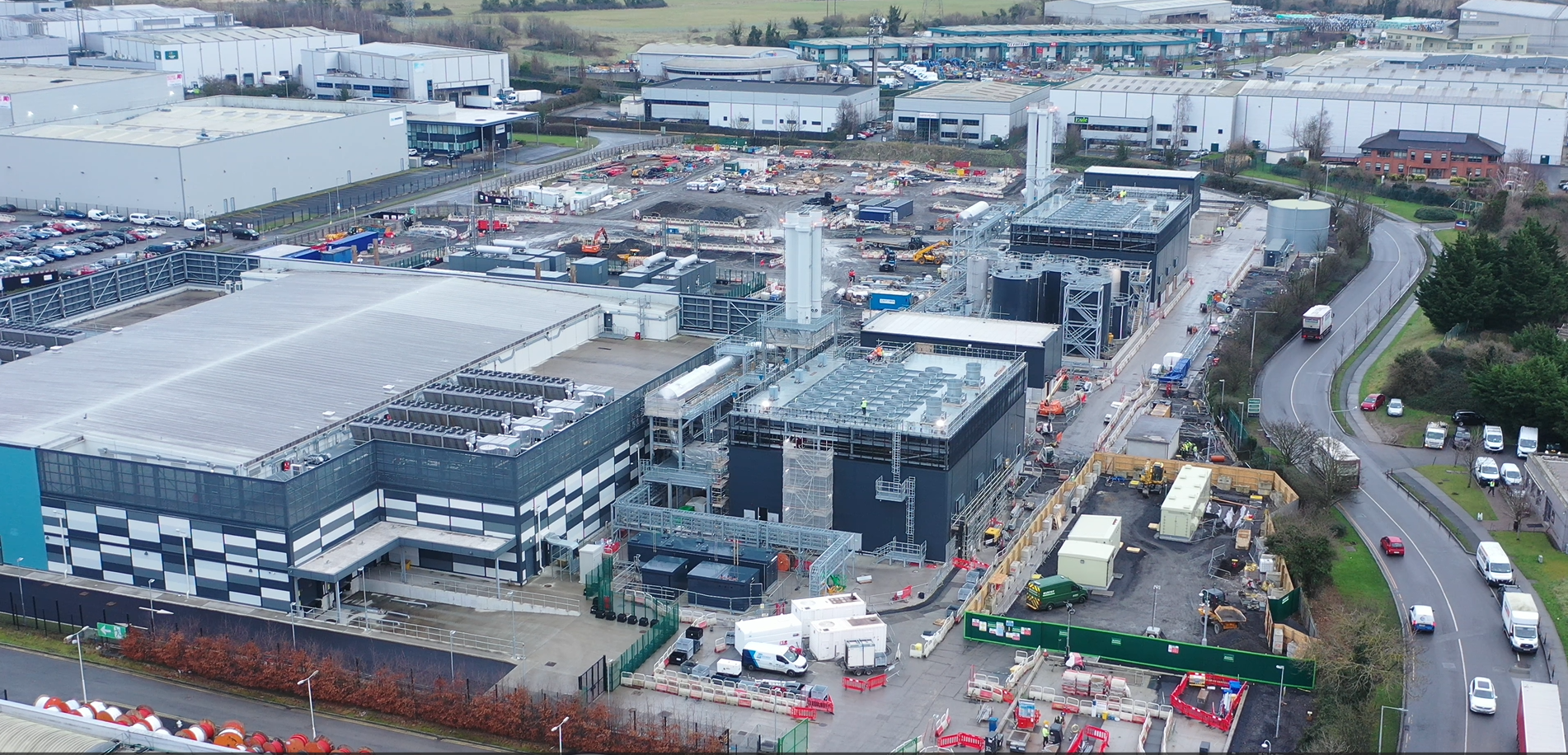
              To meet Pure DC’s needs, AVK developed a bespoke microgrid solution that includes three independent energy buildings, which together form a fully integrated energy centre solution.  

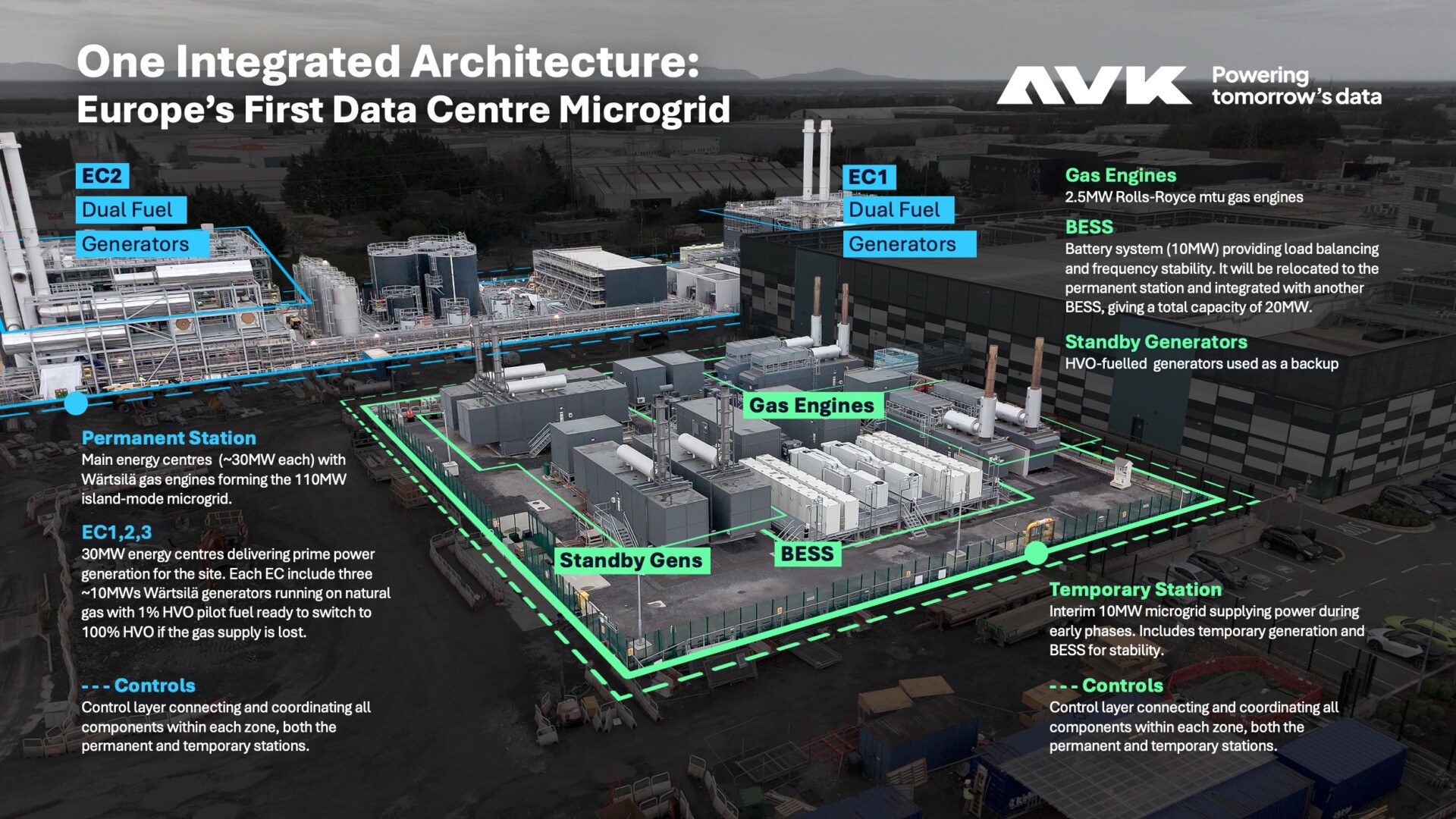
              Each energy centre is designed to generate up to 30MW of power, utilising a combination of Wärtsilä generators and supported by a battery energy storage system (BESS). An initial 10MW of BESS capacity is distributed between EC1 and EC2. A further 10MW currently serving temporary infrastructure will be decommissioned and relocated to EC3, optimising long-term stability and load management across the microgrid and bringing the total installed capacity to 110MW.  

              The infrastructure has also been designed to be CHP-ready. Should local demand arise in the future, it will be possible to recover heat from the Wärtsilä engines and feed it into a district heating network, further improving overall energy efficiency.  

              A rainwater harvesting system is also planned for installation. Rather than using mains water for any water use associated with the Wärtsilä engines, rainwater will be collected and treated on-site, reducing the facility’s demand on local water infrastructure.  

              The combination of Wärtsilä generators and battery storage ensures stable, resilient, and off-grid power for Pure DC’s operations. The 20MW BESS acts as a dynamic power stabiliser, improving efficiency, response time, in the microgrid by reducing fuel consumption, lowering emissions, and optimising generator usage while also paving the way for future renewable energy integration. 

              Gas was chosen as the primary fuel due to its reliability and relatively lower emissions compared to diesel or other fossil fuels. However, to enhance energy security and provide a sustainable alternative, HVO will serve as a backup fuel, ensuring continuous power in the event of gas supply disruptions. While this solution does not yet incorporate fully renewable energy, the combination of gas and HVO represents a cleaner and more flexible approach to delivering the scale of power required by Pure DC.  

              The temporary energy centre  

              In large-scale data centre projects, temporary power systems play a crucial role during the construction and commissioning phases. For this project, AVK deployed a 10MW temporary energy centre, ensuring that essential services and initial operations could proceed without delay, even before the permanent energy infrastructure was fully operational. 

              Once the permanent energy centres are completed and fully functional, the reliance on temporary power systems diminishes. Permanent systems are typically more efficient, reliable, and tailored to the data centre’s specific energy demands. Therefore, temporary setups are dismantled to reduce redundancy, lower operational costs, and streamline maintenance processes.  

              In summary, temporary power systems are indispensable for bridging the gap between the start of construction and the full commissioning of permanent power infrastructures in data centres. They ensure that projects stay on schedule and that initial operations can commence without waiting for the completion of all permanent facilities.  

              System architecture and energy stability  

              The temporary energy centre operates using high-speed Rolls-Royce’s mtu gas engines as the primary power source. To ensure redundancy and system resilience, the temporary setup also includes standby generators powered by HVO or diesel, which activate in case of gas supply interruptions or engine failures. These standby units are housed in separate engine blocks, operating independently from the gas generators.  

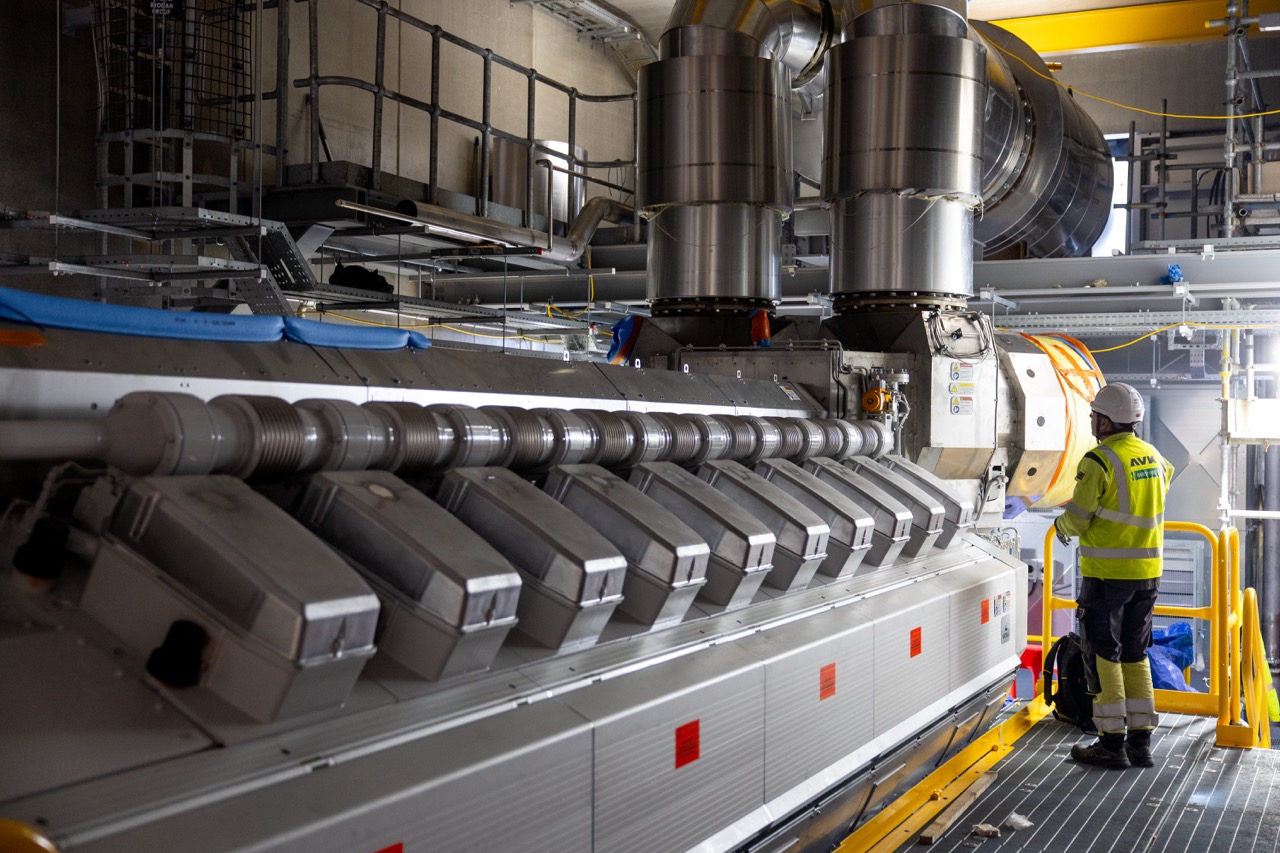
              For the permanent energy centre, the setup is slightly different. The Wärtsilä engines in EC1, EC2, and EC3 are dual-fuel capable, meaning they can run primarily on gas but can also seamlessly switch to HVO if needed. This feature enhances system flexibility and energy security.   

              Additionally, the battery energy storage system (BESS) plays a crucial role in stabilising the microgrid. The BESS absorbs load fluctuations and ensures a consistent power supply, allowing the microgrid to function efficiently. The current 10MW battery system will be expanded to 20MW as the energy centre transitions to full capacity, further strengthening grid stability and performance. 

              The critical role of service  

              This project represents a first for AVK, marking a significant milestone in prime power and microgrid service operations. The AVK Dublin service team will invest significant time preparing for the operation phase to ensure that all engineers are ready to support this critical infrastructure.  

              Unlike traditional standby power generation, where maintenance follows scheduled visits, this fully off-grid prime power system requires a more dynamic and responsive approach. The engines run continuously, meaning they must undergo regular planned services scheduled in advance, to ensure there is no impact on the system’s resilience. Concurrent maintenance of the entire system was a key requirement of the original design. This demands a dedicated engineering resource pool, with teams performing both routine servicing and rapid-response interventions to prevent downtime.  

              Service has been deeply involved throughout the process to ensure maintenance of the plant was considered at all stages of the design and construction. Unlike conventional data centre setups that rely on utility power as a fallback, this microgrid is the sole power source for the facility. There is no external redundancy – AVK’s solution is the grid. This places responsibility on a service team to plan and execute the maintenance to ensure constant uptime, meeting the client’s high expectations for reliability and resilience. Coordination and communication with Pure DC Operations is a vital component.  

              Keeping the microgrid operational is not just about maintenance, it’s about ensuring uninterrupted, mission-critical power in one of the most advanced and reliable off-grid data centre projects in the world.  

              The project delivery  

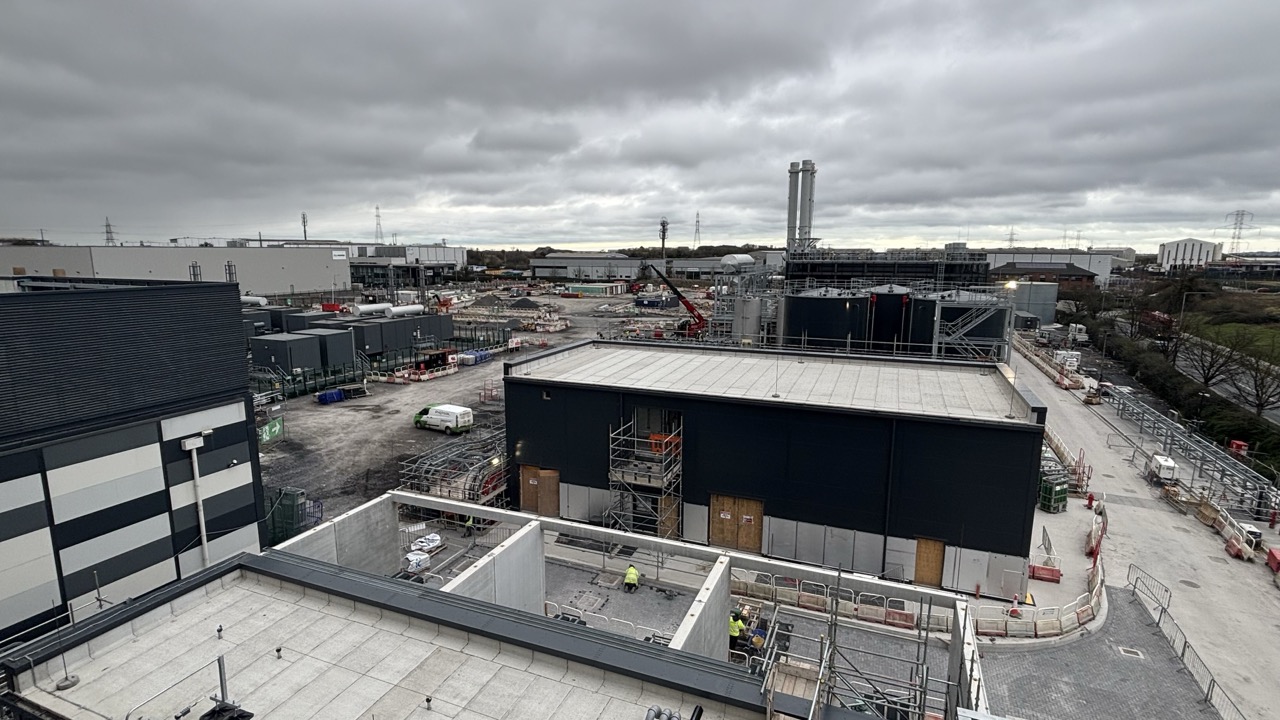
              The project officially began in early 2024, with phased construction and commissioning designed to ensure seamless delivery. Key milestones included the successful commissioning of the temporary energy centre and the arrival of Wärtsilä engines, which required precise nighttime transportation and coordination.   

              Our current status sees us with more than 75% of interconnecting systems are installed, EC1 and EC2 are expected to be fully operational in late 2026 – the commissioning process just beginning. Collaboration with stakeholders (including local authorities, logistics providers, and Pure DC) was essential. Each phase was meticulously planned to align with the broader project timeline while minimising disruption to the surrounding community.  

              What value have we provided?  

              AVK delivered an innovative and scalable power solution tailored to Pure DC’s unique requirements. By implementing a fully off-grid microgrid, AVK not only resolved the immediate challenge of powering the Dublin data centre but also demonstrated our ability to adapt to complex logistical and technical demands.   

              This project positions AVK as a leader in providing independent energy solutions for critical infrastructure, with a robust design that ensures reliability through gas as the primary fuel source.  

              The results  

              The microgrid solution, once fully operational, will consist of three independent energy centres, for an overall capacity of up to 30MW each with an additional 20MW provided by battery storage. The full microgrid will have a combined output of 110MW, allowing Pure DC to operate entirely in island mode while maintaining the reliability and efficiency required for high-performance computing.  

              The decision to use gas, according to our team at AVK, reflects a balance between practicality and sustainability. While not renewable, gas offers a cleaner alternative to traditional fossil fuels, producing lower emissions. Additionally, the system is designed with HVO backup storage, allowing for continued operation even in the event of gas supply issues. This hybrid approach enhances energy resilience.  

              By leveraging AVK’s expertise, Pure DC is now better equipped to meet the demands of its clients while setting a precedent for future projects.   

              Alan Morrison, AVK’s Project Manager, shared his thoughts:   

              This project is truly groundbreaking, and AVK’s expertise has been invaluable. The team has demonstrated exceptional problem-solving skills, ensuring that every challenge was met with innovative solutions. This collaboration sets the stage for future successes in energy-independent data centres. 

              In conclusion  

              This project highlights the potential for scaling similar solutions in other regions facing grid limitations. Launching the first technology of its kind in the European data centre industry has demanded confidence in our leadership, skillset, and forward-thinking innovation. This project has taken the dedication of varying departments, collaboration with multiple stakeholders and external companies, and the organisation to keep processes running seamlessly. We’re proud of the achievements that our collaboration with Pure DC has produced.   

              AVK and Pure DC’s collaboration has paved the way for data centre developers who are interested in utilising innovative technology that provides a superior alternative to grid power. This is the first off-grid microgrid in Europe, powering an operational data centre. We anticipate many data centre operators may begin to follow suit.  


              (This case study has been reviewed and undergone revisions by AVK technical engineers. The perspective communicated is solely AVK’s.)