For most of data centre history, power was an engineering problem. It was a technical specification to be met, a utility to be procured, and a backup system to be tested. It sat in the operations team’s domain and was largely invisible to investors, boards, and commercial teams.
That model is finished.
A 60MW data centre now loses approximately $14.2 million for every month of delay. In a market where AI workloads are driving facilities to hundreds of megawatts, a missed commissioning window doesn’t just inconvenience operations anymore; it is a material hit to project returns, investor confidence, and in some cases, the viability of the entire development.
Power delays move markets
Europe’s data centre project pipeline now equals 130% of existing capacity; but based on current modelling, capacity will likely grow by just 70% because of delays and power constraints. The gap between what is planned and what can actually be delivered is not a temporary bottleneck, but a structural constraint with direct financial consequences.
Grid connection queues in parts of Europe are already outlasting construction timelines, with some markets projecting waits of up to seven years. Dublin and Amsterdam have both had to pause new projects, citing lack of grid availability and the inability to integrate new large power loads. In mature hub markets including Frankfurt, London, and Paris, data centres tend to cluster precisely where local grids are most strained.
The financial consequences compound rapidly across multiple vectors:
Delayed revenue
Racks stay dark, missing committed capital returns while hyperscaler tenants wait for activation.
Idle capital costs
Land, construction, mechanical and electrical fit-out sits unproductive, generating financing charges with no output.
Operational overhead
Construction teams and contractors bill fixed costs; equipment arrives early requiring storage, insurance, and rescheduling.
Contractual penalties
Pre-let developments trigger penalties when commissioning slips miss tenant delivery dates.
Reputational damage
Hyperscalers with tight planning cycles remember missed windows; one failure closes doors built over years.
Western Europe is expected to attract around €176 billion in data centre investment between 2026 and 2031, but grid constraints will determine how much can actually be deployed in core markets. Projects that cannot secure timely power will face delays, relocation, or cancellation. Value is increasingly defined by certainty of power delivery, and sites without credible access are viewed as speculative regardless of location.
Most analysis focuses on lost rack revenue. That is understandable, but incomplete. The downstream effects – financing costs on idle assets, contractor overheads, location economics shifting mid-project – compound in ways financial models often miss. A single 12-month delay can turn viable economics marginal in a market where tenant relationships drive long-term returns.
Why investors care about energy certainty
The investor community has reached its own conclusions about power risk. As of early 2026, nearly a third of all planned new data centre capacity is being designed to operate independently of grid infrastructure, up from effectively zero just a year earlier. This shift reflects not only the practical constraints of grid availability but a deliberate reframing of on-site power generation from a workaround to a strategic infrastructure decision.
Infrastructure funds are beginning to treat dispatchable power and microgrid assets as investable categories in their own right, separate from and complementary to the data centre assets they support. Our CEO Ben Pritchard has described a new class of investor emerging around the microgrid opportunity: infrastructure funds interested specifically in the power asset, not the compute facility it serves.
This separation of the power asset from the compute asset has significant implications for how projects are structured, financed, and valued. A data centre developer that has secured committed power through a third-party microgrid operator has a fundamentally different risk profile to one that is waiting for a grid connection. Lenders, investors, and hyperscaler tenants are beginning to price that difference.
DC Byte’s latest analysis confirms that markets with stable power supply, clear planning rules, and reliable energy infrastructure are delivering capacity more consistently, with smaller gaps between announced, committed, and delivered supply. Certainty has become a competitive advantage. The operators that have it can move faster, command better terms, and attract higher-quality tenants. The ones that do not are competing for space in an increasingly congested queue.
From procurement to strategy
What this means in practice is that energy strategy needs to move out of the engineering function and into the boardroom: not as a technical briefing, but as a commercial and financial priority.
That means asking different questions at the development planning stage. The issue is no longer simply what the grid connection timeline is, but what happens if that timeline slips by 12 months, and what the financial exposure would be.
For grid-constrained markets – which in 2026 means most of Europe’s major data centre hubs like Dublin, Frankfurt, Amsterdam, and London – the answer increasingly involves on-site generation as primary strategy, not just contingency planning. That does not just mean installing generators. It means designing the facility’s power architecture around a delivered-power model that provides certainty for financial close, tenant commitment, and delivery confidence, while grid connection provides additional capacity and redundancy as it becomes available.
The Dublin proof point
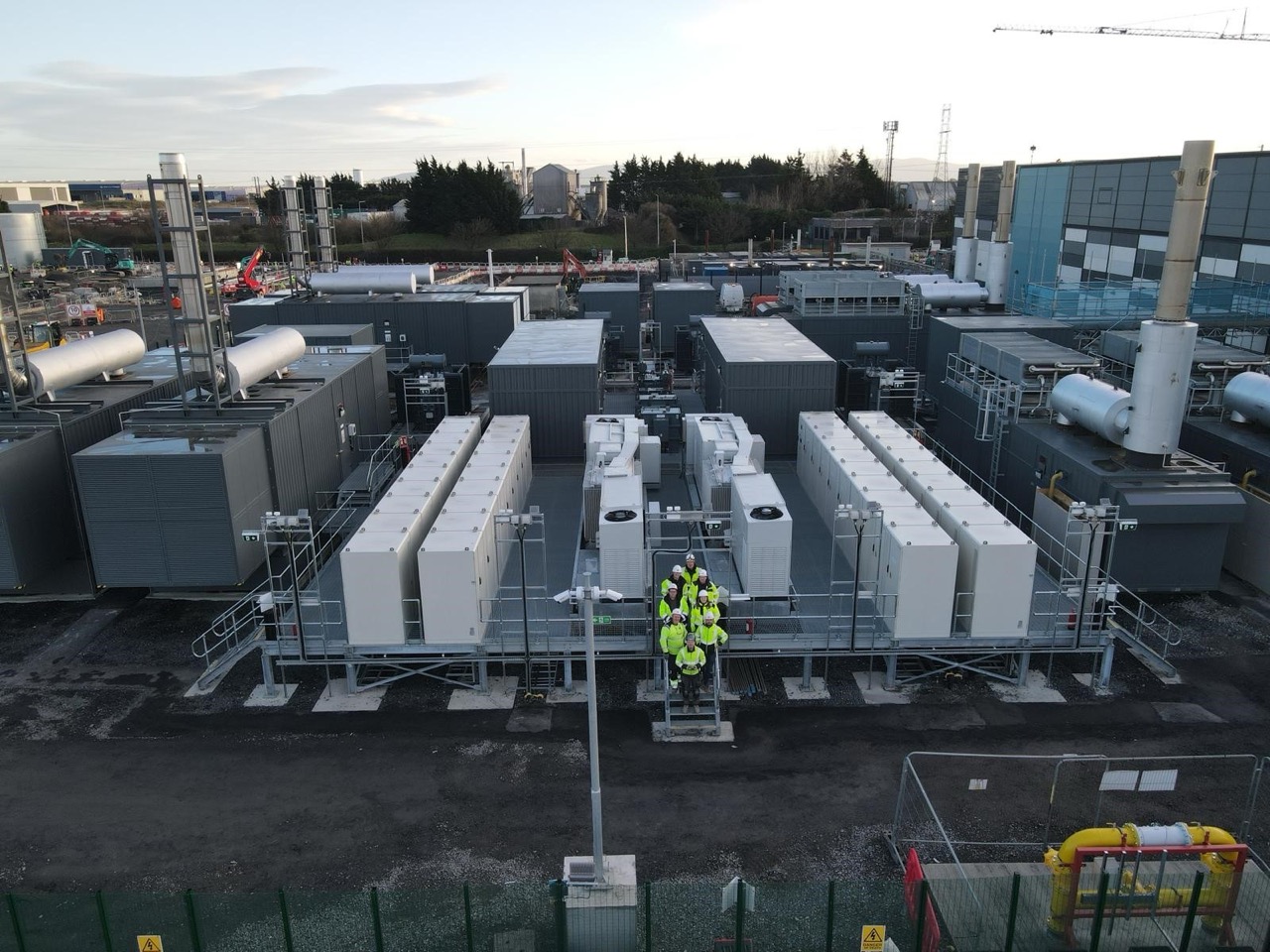
Earlier this year, Pure DC and AVK brought Europe’s first large-scale data centre microgrid live at Pure DC’s Dublin campus: a 110MW on-site system, entirely independent of the national grid, capable of supporting the full operational requirements of the facility before any grid connection is in place.
Dublin is an instructive market. Ireland’s grid operator has been managing data centre demand that reached 22% of national electricity in 2024, prompting a temporary moratorium on new connections that has since been eased but not resolved. The delays facing developers in Ireland are not temporary bottlenecks. They reflect a structural mismatch between the speed of digital infrastructure demand and the pace of national grid reinforcement, a mismatch also visible in Germany, the Netherlands and the UK.
The Pure DC project demonstrates that a commercially viable, delivery-ready alternative exists. The energy centres powering the campus run primarily on gas with HVO capability, are hydrogen-blend ready for future decarbonisation, and incorporate battery storage for grid stability. They were designed not as a substitute for grid connection but as a complement to it, delivering the power certainty the project needed to reach financial close and begin commissioning while the grid connection proceeds in parallel.
Gary Wojtaszek, Pure DC’s CEO, put it directly at the project’s launch: “the biggest barrier to deploying AI infrastructure in Europe today isn’t technology – it’s power.” The microgrid removed that barrier.
Treating energy as a strategic asset
The data centre industry has spent three decades treating energy as a commodity input, something to be sourced as cheaply and reliably as possible from whoever would provide it. That model made sense when grid connections were available, when the cost of power was the primary variable, and when development moved more slowly than it does now.
None of those conditions hold today.
Energy price is no longer what determines whether a project reaches financial close, meets commissioning commitments, and retains the confidence of hyperscaler tenants. Today, power availability has become the binding constraint in most major development markets.
The operators and developers who have understood this – and who have built power strategy into their commercial and financial planning from day one – are the ones delivering capacity when and where the market needs it.
For everyone else, power is still an engineering problem. Until suddenly it isn’t. By then, it’s too late.