As regulations on carbon emissions tighten, cleaner hydrogen-powered systems will offer a way for data centres to comply with future environmental standards. Hydrogen fuel cells also offer a reliable and continuous power supply, which is crucial for data centres that require uninterrupted operation. And they are scalable, so they can be adjusted to meet the varying power demands of different data centre sizes.
Market snapshot
In 2023, EU-27 hydrogen consumption stood at 7.3 million tonnes (megatonnes or Mt), equivalent to around 2% of total EU energy consumption. The first hydrogen-powered backup fuel cells for data centres were deployed in the Netherlands in 2023 and adoption is still as low as 3%, but according to the EUDCA hydrogen fuel cells will be on the agenda for 19% of operators by 2027. According to the European Hydrogen Observatory the hydrogen market will grow 56% to 2030 and 127% from 2030 to 2040. The European Commission expects renewable hydrogen to cover around 10% of EU energy needs by 2050.
Reality check
However, the hydrogen market has a very long way to go in terms of feasibility for data centre facilities and, in particular, environmental impact. While definitions are still being agreed, we should be wary when people talk about hydrogen as a universal green solution due to these limitations. Although hydrogen is one of the most abundant elements in the world, manufacturing it is incredibly energy intensive, and currently, a huge proportion of hydrogen production relies on fossil fuels. Just because a facility can run on hydrogen doesn’t mean that its operations are automatically green.
The hydrogen rainbow
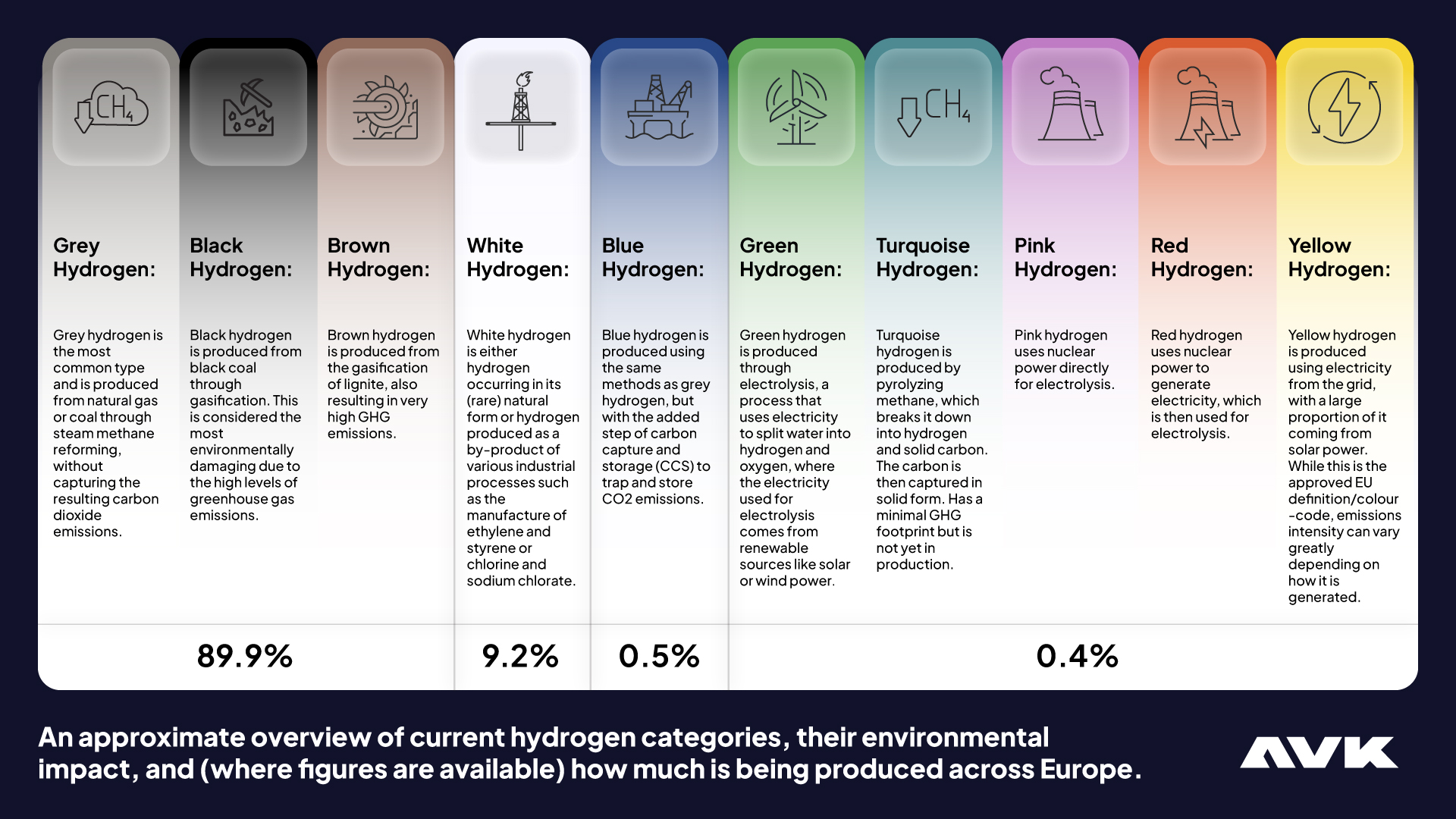
Hydrogen fuel is classified into different types based on its production method and resulting environmental impact, often denoted by colour codes. The following table gives an approximate overview of the current categories, their environmental impact, and (where figures are available) how much is being produced across Europe: